PhD Update #2: Past the Finish Line
A strong finish - and possible next steps.

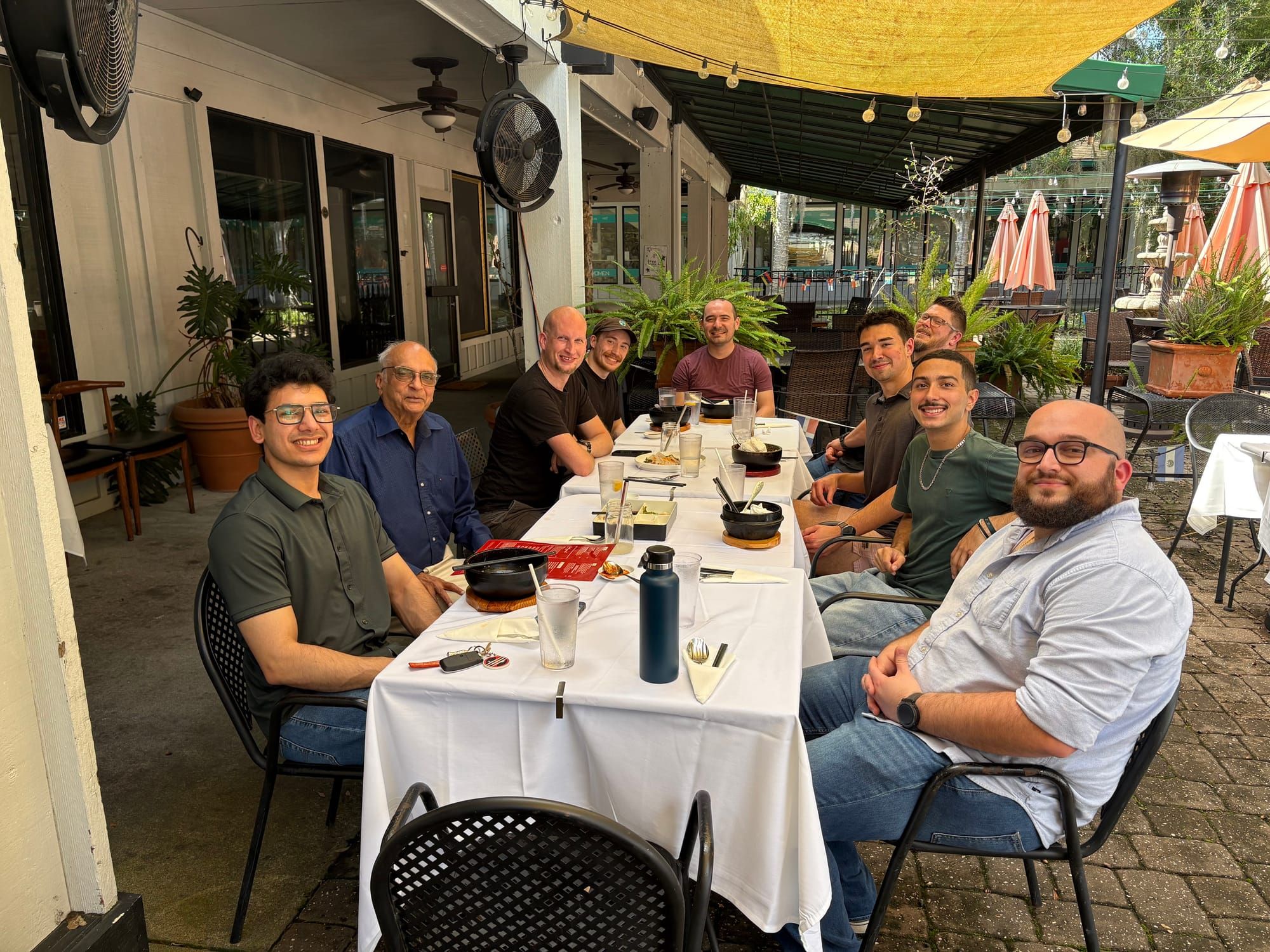
It's been almost two years since my qualifying exam, and a lot has happened since then. On October 19, 2026, I defended my dissertation... and passed. I am now a PhD in chemical engineering, and will be graduating in December.
For those who missed my last update, the Narayanan Research Group works on novel technologies that exploit fluid phenomena. Working here requires a deep, fundamental understanding of the underlying physics since that is what leads to technological breakthroughs.
My time as a doctoral researcher in the Narayanan Research Group spanned from August 16, 2023 to October 19, 2026. In these 1160 days, I did the following in roughly chronological order:
- Studied a 11-page derivation, including coupled partial differential equations, leading to an equation in a paper from 1967. That was the basis for the research project.
- Ran multiple trials on an experimental liquid-phase apparatus built by a previous master's student to test a novel mechanism that increases the effective diffusivity of a solute in a carrier fluid.
- Engineered an experimental gas-phase apparatus from off-the-shelf parts (and a few 3D-printed and custom-machined parts). This included compressed gas tanks, regulators, electronic gas sensors, airtight seals, moving parts, microcontrollers, and mass flow controllers. Total cost was ~$13,000.
- Wrote hundreds of lines of Python and C++ code to run the machine, log the sensor readings, and perform data analysis on them.
- Ran multiple trials on said gas-phase apparatus, enough to get a clear picture of how it increased solute transport (this turned out to be tens to thousands of times natural diffusion!)
- Graded the exams and quizzes for 74 students in an undergraduate Python for chemical engineering course (I also held office hours every week, but few students came).
- Presented my research at the Florida Fluids Symposium, the Florida Space Summit, and the American Institute of Chemical Engineers Annual Meeting. Next up is the American Society of Gravitational and Space Research (ASGSR) Annual Meeting in Washington DC.
- Developed a ~20-page derivation to predict the transport of solutes in the gas-phase experiment. Even though the theory is the same for both phases, the gas-phase experiment had different boundary conditions that defied previous attempts to model it in 1996 and 2001. My derivation resulted in curves that closely approximated the empirical data, solving a 25+ year old modeling gap.
- Completed a 200-page dissertation including all derivations and results.
Notice that I am being deliberately vague about how the device works. The papers have not been published yet. My dissertation will be embargoed (kept secret) for two years to protect any publications and patents from being "scooped" (see my other blog post for what that means).
I achieved these with very little supervision and help, and under tight financial constraints, which consequently restricted the amount of time I could spend on this project. Unlike some previous workers in my group, I did not get any huge NASA/NSF fellowships even after applying for the highly competitive NASA Space Technology Graduate Research Opportunity (NSTGRO) twice. The grants I did get came from one of the university's organizations, the Astraeus Space Institute, and the Florida Space Grant Consortium (FSGC). Both organizations got their funding from NASA, so I can say that I was indirectly funded by NASA. At some point during these three years, I got my residency reclassified to in-state tuition but that didn't extend my timeline much.
Because it's 2026, this writeup wouldn't be complete without a description of how I used AI tools. I did not use AI for the first two years of this project partially out of skepticism of what it could do and fear of it eroding my mental capacity. The turning point came when I had to change one of the solutes in the experiment, which meant changing the sensors. The sensors for each solute had to come from two different companies, and they had to be installed on the same Arduino circuit. The coding to get both types of sensor to work on the same circuit was non-trivial, and Google Gemini handled it easily. What would have taken a week of frustration was reduced to just two days' work.
So what's next in 2027?
I will publish my findings in a separate peer-reviewed paper or two. In addition to my job/postdoc search, I would like to find a way to continue this work as it pertains to aerospace life support.
For future posts, I would like to discuss various aspects of the PhD experience, from figuring out technical solutions to accessibility hurdles as a deaf researcher. Which topics would you like me to expand on?